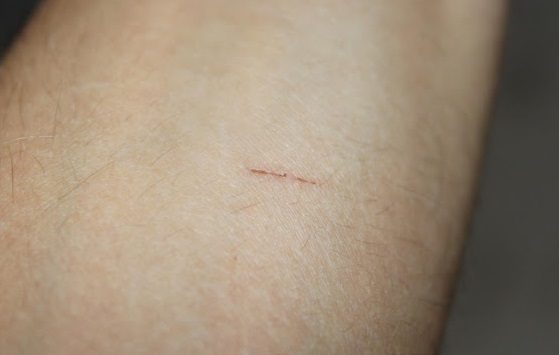
Why Do So Many People Have the Same Small Scar? The Mystery Behind a Global Mark
Why Do So Many People Have a Small Round Scar on Their Upper Arm?
Have you ever noticed a small, round scar on your upper arm and wondered where it came from?
Maybe you’ve had it since childhood, or perhaps you’ve noticed the same mark on your parents or grandparents. For many people, this distinctive scar is connected to an important moment in medical history: the smallpox vaccination.
Although not every round scar has the same cause, the traditional smallpox vaccine often left a recognizable mark that millions of people carried for decades.
What Is the Smallpox Vaccination Scar?
The smallpox vaccination scar is commonly found on the upper arm. Depending on the person, it may appear as a small depression, a circular mark, or a cluster of tiny scars.
Its appearance varies because everyone’s skin heals differently.
Smallpox was a serious infectious disease caused by the variola virus. It caused widespread illness and death for centuries, making vaccination an important public-health priority around the world.
In 1980, the World Health Assembly officially declared smallpox eradicated, marking a historic achievement in global health.
Why Did the Vaccine Leave a Scar?
Unlike many modern vaccines, the traditional smallpox vaccine was administered using a special two-pronged instrument called a bifurcated needle.
Healthcare workers used the needle to make several small punctures in the skin, allowing the vaccine to enter the tissue.
The vaccination site typically developed a local reaction. A raised lesion could form, followed by crusting and healing. In some people, this process left a permanent scar.
The size and appearance of the mark depended on individual healing and other factors. Not everyone developed a clearly visible scar.
Why Did So Many People Have the Same Mark?
Smallpox vaccination programs operated across many countries for decades. Because the vaccine was administered using a similar technique, people from different backgrounds often developed scars with a recognizable appearance.
For many families, the mark became a familiar feature shared by parents, grandparents, and other relatives.
It can also reflect differences between generations. People who received smallpox vaccination may have the scar, while those born after routine vaccination ended in their country generally do not.
Routine smallpox vaccination is no longer part of ordinary childhood immunization in most countries because the disease has been eradicated.
Does Every Round Scar Mean Someone Received the Smallpox Vaccine?
No. A round scar on the upper arm can have several possible causes, including an old injury, a burn, a skin infection, or another vaccination.
Although a characteristic scar may suggest previous smallpox vaccination, its appearance alone cannot confirm its origin.
If you want to know where an old scar came from, vaccination records or family medical history may provide useful clues.
How Was Smallpox Eradicated?
The eradication of smallpox required years of international cooperation. Vaccination played a major role, alongside disease surveillance, identifying cases, tracing contacts, and containing outbreaks.
The last naturally occurring case of smallpox was reported in Somalia in 1977. In 1980, the World Health Assembly declared the disease eradicated.
This remains one of the greatest achievements in public-health history.
The small scar left by vaccination can therefore serve as a reminder of the worldwide effort that helped eliminate a disease that had affected humanity for centuries.
Frequently Asked Questions
What is the small round scar on my upper arm?
It may be a smallpox vaccination scar, particularly if you were born in a generation that routinely received the vaccine. However, appearance alone cannot establish the cause.
Why did the smallpox vaccine leave a mark?
The traditional vaccine was administered through multiple small skin punctures. The resulting skin reaction sometimes healed into a permanent scar.
Did everyone who received the vaccine develop a scar?
No. Scars varied in appearance and visibility, and some became less noticeable over time.
Is smallpox vaccination still routine?
No. Routine smallpox vaccination ended in most countries after the disease was eradicated. Vaccination may still be used for certain specialized public-health purposes.
Does the scar mean I had smallpox?
Not necessarily. The familiar single scar on the upper arm is often associated with vaccination rather than the disease itself.
A Small Mark With a Remarkable History
A scar you’ve had for years can be easy to overlook. Yet for many people, the smallpox vaccination mark connects their personal history to a major achievement in medicine.
It reflects decades of scientific work, vaccination programs, and international cooperation that helped eliminate smallpox from natural circulation.
Not every upper-arm scar has this origin, but when the history fits, that little mark can tell a fascinating story.
Sometimes, an ordinary detail carries a reminder of something extraordinary.
Final Thoughts
If you have a small, round scar on your upper arm, it may be connected to a smallpox vaccination you received years ago. The only way to investigate its origin more confidently is to consider your vaccination history and other available records.
What looks like a tiny mark may be a reminder of one of the most significant public-health achievements in human history.
One small scar, with a remarkable story behind it.
Did you notice this scar on your own arm or on a family member? Share your experience in the comments.